Your First Open Match: A Low-Pressure Way to Join In
Your first open match is easier to join when you learn the group’s shared rules, settle practical questions and decide whether the format suits you.
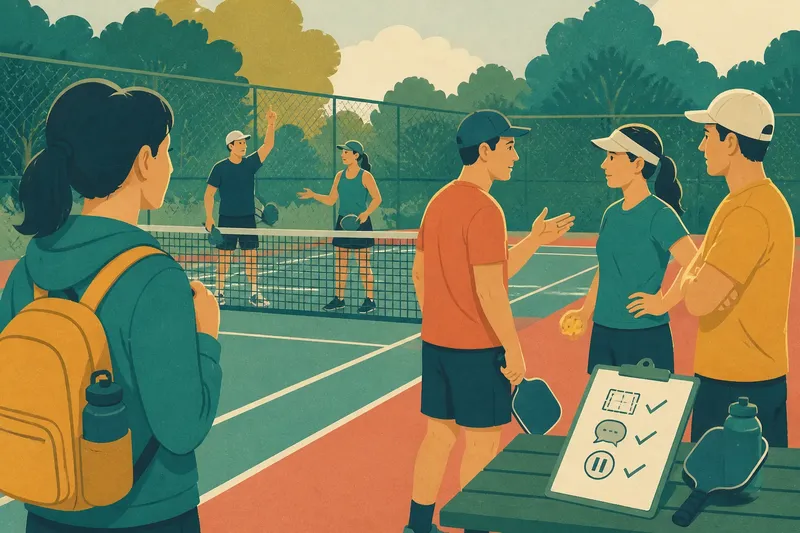
A first open match feels less uncertain when you know how the group makes decisions together. At a shared outdoor court, for instance, the useful questions may be who calls a boundary, how a disputed point is settled and whether players can pause to clarify a rule. These agreements shape the experience as much as the game itself.
Open play does not mean that every choice is improvised. Groups often rely on familiar conventions, but those conventions can differ from one session to another. Before joining, look for how players communicate, how they handle disagreements and whether everyone appears to understand the same rules.
Notice how the group shares decisions
Choose a place where you can see and hear the playing area without standing in the way. Watch what happens when a boundary is close, a point is disputed or someone needs a pause. Notice whether players make a call themselves, check with an opponent or turn to an organiser.
These moments reveal the group’s habits around fairness and communication. A calm exchange does not require everyone to agree immediately; it does require a way to clarify what happened and continue. If a call is hard to hear, make a note to ask about it rather than assuming the group uses the convention you know.
Pay attention to the language players use for a restart or pause. The same word can mean different things in different activities, so listen for how people act after it is said.
Agree on the rules that affect your first turn
Before joining, ask about the conventions that could change what you do on court or in the playing area. A useful opening is, “Which rules should I know before I start?” Follow up on any detail that affects boundaries, contact, equipment or the way play restarts.
For a point that could be disputed, ask who makes the call and what happens if players see it differently. For a safety concern, ask how anyone can pause play. Keep the conversation brief, but make sure you understand the answer before taking part.
If the group uses a rule you have not encountered, repeat it back in your own words: “So we pause when someone calls that?” The other player can correct any misunderstanding before it matters.
Check that everyone has the same understanding
Shared rules work best when they are stated plainly and applied consistently. Listen for whether the explanation applies to everyone, including regular players, rather than only to newcomers. If you hear different versions, ask the organiser which convention the group is using for this session.
Imagine you arrive at an outdoor court where a close boundary call is handled differently from what you expect. You watch a point, ask a player who makes that call, and hear that each side calls its own boundary while either player may request a pause to clarify. You repeat that back, and the player confirms it; your resulting decision is to join with those conventions in mind, or to wait if you are not comfortable with them.
When a rule remains unclear, do not settle it by guessing in the middle of play. Ask at the next pause, and follow the group’s agreed process for the current session.
Questions that help you judge the format?
What should I do if players give different rule explanations?
Ask the organiser or the person coordinating play which version applies to the session. If no one can settle the point, clarify how the group will handle it before joining.
How can I raise a concern about a call?
Use the group’s agreed pause or discussion process, and describe the specific moment without accusing anyone. If there is no clear process, ask the organiser how the group prefers to resolve disputed calls.
Can I ask for a rule to be explained again?
Yes. Ask for a short clarification at a pause, especially if the rule affects safety, boundaries or fair play. It is better to confirm the convention than to act on a guess.
Is it all right to leave if the format does not suit me?
Yes. Tell the organiser or a nearby player that you are leaving, so they know you are no longer taking part. You do not need to give a detailed reason.
Make a clear choice before joining
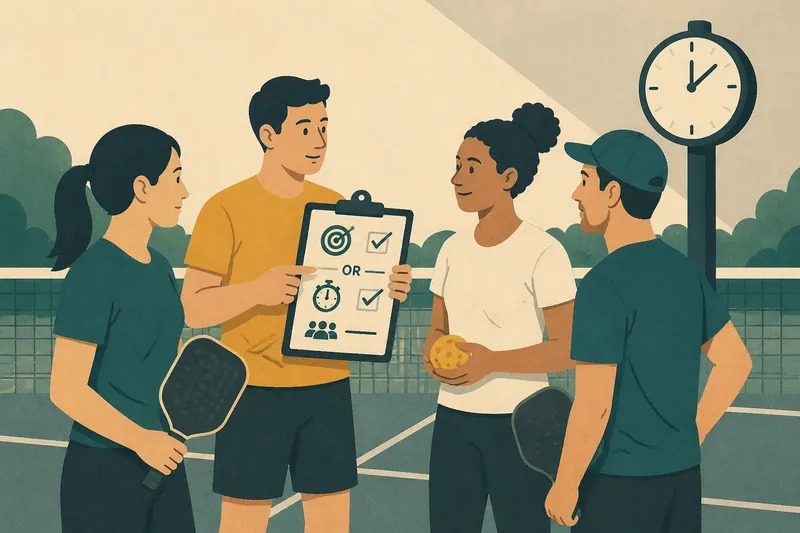
Once you understand the group’s approach to calls, pauses and disputed moments, decide whether you are comfortable playing under those conventions. You can join, ask for another clarification or wait and observe longer. If a rule affects safety and remains uncertain, do not take part until it has been explained clearly.
After your first turn, notice whether the group applies its agreements in a way you can follow. If a disagreement arises, use the stated process rather than trying to resolve it alone. If the process is absent or confusing, ask the organiser what to do next.
A first open match is easier to assess when you focus on shared rules, not just the score. Learn how this group handles calls, pauses and disagreements; then choose whether its way of playing works for you.