Why a Short Match Can Keep More Players Involved
Short matches create clearer chances to join or rotate. Compare round formats and choose an interval that keeps open play moving without constant stops.

A short match can make rotation easier to organise, but only if its ending has a clear purpose. In open-format sport, the useful question is not how quickly to stop play; it is how to create a reliable pause for checking the queue, changing teams or letting someone rest.
There is no interval that suits every group. A busy court may need frequent opportunities to reorganise, while a settled group may prefer fewer interruptions. Choose a format that gives players enough time to play and makes the next change easy to understand.
Use the end of a round to reset the game
A round boundary is a practical moment to check whether the game still fits the people present. The group can count the players, notice whether anyone needs a break and decide whether the next round should keep its teams or start with a reshuffle. This is different from treating every boundary as an automatic invitation to rotate: sometimes continuity matters more than changing the line-up.
A clear ending also prevents small decisions from interrupting play. If the group knows that team changes are considered at an agreed pause, there is less need to stop midway through a point or possession to settle who should move.
Make the boundary visible with a shared cue, such as a call at a natural pause or the completion of an agreed game event.
Choose a format that fits the game’s rhythm
Fixed rounds create a predictable reset
In fixed rounds, play stops at an agreed cue and the group takes a moment to adjust. This suits games where a pause is already natural, or where changing the teams during play would be confusing. The cue should be easy for everyone to recognise; a vague promise to stop “soon” leaves players unsure when decisions will happen.
The trade-off is interruption. If the cue repeatedly cuts off a close passage of play, move it to a more natural stopping point or make the rounds less frequent.
Longer blocks preserve continuity
Longer blocks give players time to settle into a game and keep established teams together for a while. They can work well when the group is stable and few people are waiting. The group should still name a review point, so a late arrival or a player needing a break does not have to wait through an unclear stretch.
Continuity is useful only while it remains fair to the people present. If the queue grows, revisit the arrangement at the next natural pause.
Rolling substitutions keep play moving
A rolling substitution replaces one player during a round, using a handover point the group has agreed. It avoids stopping the whole game, but it asks players to keep track of whose turn is next and where the swap happens. A boundary line or a designated entry point can make the handover easier to see.
This format is less suitable if several players are waiting and the order is unclear. In that case, use a fixed reset so the group can organise the queue together.
Check the signs that an interval needs changing
Review the format at a pause, using what is happening on the court rather than debating an ideal interval in the abstract. For each observation, decide whether to keep the current arrangement or try the alternative at the next round.
- Check the queue: If people are waiting through repeated rounds, make the next reset sooner; otherwise, keep the current spacing and preserve continuity.
- Check how often play stops mid-flow: If the cue interrupts active play repeatedly, move it to a natural boundary; otherwise, retain the cue.
- Check whether everyone can identify the next change: If players are asking when or where to rotate, state one shared cue and handover point; otherwise, leave the instructions alone.
- Check whether teams remain workable after arrivals or departures: If sides become uneven, rebalance at the next pause; otherwise, keep teams together for another round.
- Check whether a player can sit out without delaying the game: If someone needs a break, make room at the next boundary or use the agreed rolling handover; otherwise, continue as planned.
- Check whether players have enough uninterrupted play: If rounds feel repeatedly cut short, lengthen the blocks; otherwise, keep the present interval.
What should the group decide about match intervals?
Should every round end with a team change?
No. A boundary can be a review point rather than a compulsory reshuffle. Keep the teams if the game is balanced and players want continuity; change them if arrivals, departures or uneven sides make it useful.
What should happen when the queue grows?
At the next agreed pause, check how many people are waiting and whether the current format gives them a clear chance to play. If the queue is not moving, bring forward the next reset or use an orderly rotation; if it is moving steadily, keep the existing cue.
When is a rolling substitution a poor fit?
It is a poor fit when players cannot tell who is next or where the handover happens. Switch to a fixed pause if swaps are being missed or disputed; keep rolling changes if the order and entry point remain clear.
How can the group revise its interval without confusion?
Make the change at a natural pause and say what replaces the old cue. If the new arrangement produces clearer, less disruptive resets, retain it; if it creates uncertainty or more waiting, return to the previous format or adjust the handover.
Let the queue and the game’s flow guide the choice
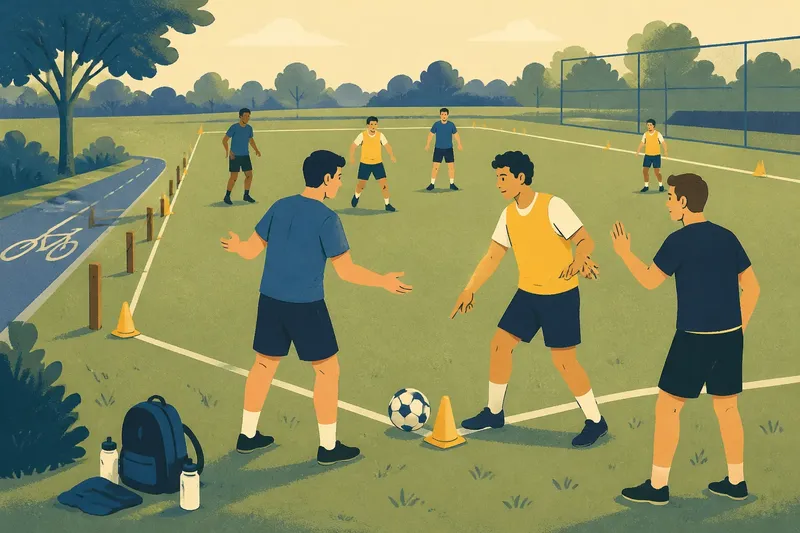
Imagine a group begins a match with two teams and three people waiting beside a marked court. The group agrees that a round ends when the current point is complete, then checks the queue before deciding whether to keep or change the teams. At the first pause, all three people are still waiting and one side has fewer players, so the group brings a waiting player into that side and leaves the other teams unchanged. The observable result is a more even next round and a shorter queue; if the game has instead been stopping too often, the group can keep the teams together for the following round and review again.
A short match works best when its boundary helps the group make one clear decision, not when it creates a fresh debate every time. For open-match intervals, keep the cue simple, watch whether the queue moves and adjust at a pause when the arrangement no longer fits.