The Myth That Open Play Needs No Ground Rules
Open play ground rules make boundaries, restarts and disputed calls clear, helping a casual match run smoothly without turning it into a formal fixture.
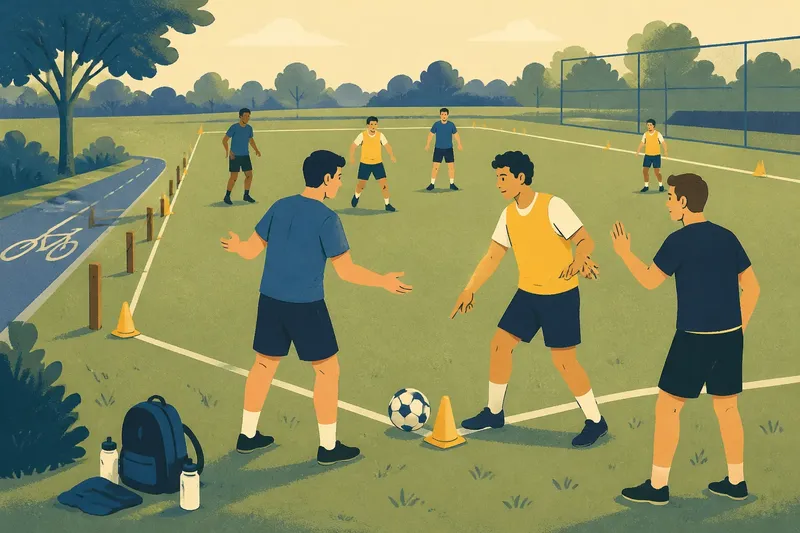
Open play ground rules are useful when a group shares a space but not the same assumptions about how a game works. In an informal football game, one player may treat a cone as the boundary while another sees it only as a marker; agreeing on one local convention before play avoids that mismatch. These are choices for this group, not claims about the standard rules of every sport.
A short agreement can cover the space, restarts and uncertain calls without borrowing a full competition rulebook. Make each choice specific enough to apply in the moment, then keep using it until the group openly agrees to change it.
Open play ground rules begin with a visible boundary
Walk the playing area and choose boundaries everyone can recognise. For an informal football game on grass, a group might set cones at the corners and agree that the boundary is the straight line between each pair. Under that local convention, the ball is out when it fully crosses the line; touching a cone alone does not decide the call.
That is one possible agreement, not a universal football rule. A group using painted court lines could instead agree that those lines define the area. The useful point is to say exactly which visible feature counts, rather than leaving players to infer whether a marker, an imagined line or a painted line takes precedence.
Check that the boundary is visible from different parts of the playing area. If a cycle path, another group’s court or parked vehicles sit nearby, mark a clear limit that keeps play away from them. If cones are hard to see against the surface, move them or use a more visible marker.
Set one restart for each common kind of pause
For a ball that goes out, agree who restarts and where. An informal group could choose a pass from the point where the ball crossed the boundary, awarded to the side that did not touch it last. Another group may prefer a throw-in or a return to a marked spot; these are local options, so choose one and explain it in plain words.
Decide separately what happens after an ordinary interruption, such as a ball entering a neighbouring game or a player stopping to retie a shoe. The group might return the ball to the side that had possession and restart with an uncontested pass. A clear signal, such as the restarting player asking “ready?” and waiting for a reply, makes the moment play resumes easier to recognise.
For a disputed foul or touch, agree whether to stop at once or wait for a natural break. If the group chooses an immediate stop, it can use a neutral pass from the place of the incident. Keep the restart simple; extra exceptions can be settled later if they actually arise.
Use a consistent method for close calls
Players nearest to an incident often have the clearest view, but they may still disagree. A group can agree that those players make the initial call and that, if they cannot settle it, play resumes with a neutral pass from nearby. This is a local way to keep a casual game moving, not a substitute for the procedure required in organised competition.
Say who takes the neutral pass and when play is live again. If the group cannot identify who had possession, an uncontested pass can avoid turning uncertainty into an argument. If the same boundary call keeps causing confusion, adjust the markers or restate the convention before play continues.
Imagine a group playing between two rows of cones, with a pass landing beside the final cone. Two nearby players disagree about whether it crossed the agreed line. They stop briefly, use their agreed neutral pass from beside that cone and wait for the receiver to call “ready”; the observable result is that play resumes without either player having to claim certainty. The group can then check whether that marker needs moving.
Which local rules should a group settle before play?
Does an informal game need an organiser?
It does not need a formal organiser, but someone should state the agreed conventions before play starts. Any willing player can do this, and the group can confirm a change together if an issue arises.
What if someone arrives after play has started?
Pause briefly and state the boundary convention, the usual restart and the method for close calls. This gives the arriving player the same local rules as everyone else without expecting them to guess from play.
Should every disagreement stop the game?
Not necessarily; the group can let minor uncertainty run to a natural break if that is safe and consistent with its agreement. Stop when the call affects safety or the agreed restart depends on it.
Can the group change a rule mid-game?
Yes, if everyone agrees and the change is made clear before it affects the next contested moment. Apply the new convention from then on rather than reopening earlier decisions.
Check the agreement before the first pass
Use these checks to turn broad intentions into decisions the group can apply:
- Observe whether every player can see the markers; if not, move them or choose more visible ones before starting.
- Check whether the group can point to the same feature as the boundary; if it cannot, name a specific line or marker arrangement, then confirm it aloud.
- Check whether players agree what makes the ball out; if they do not, choose one local convention, such as fully crossing the line, or use the venue’s marked lines.
- Check whether everyone knows who restarts after the ball goes out; if not, choose the side and location for the restart, then state them plainly.
- Check whether ordinary interruptions have a shared restart; if they do not, choose an uncontested pass or another simple method and identify who takes it.
- Check whether players know how to settle a close call; if they do not, agree who makes the first call and use a neutral restart if those players disagree.
- Check whether everyone recognises the signal that makes the ball live; if not, choose a spoken cue or clear pass and use it after each pause.
If a detail is unlikely to arise, leave it undecided until it matters. Venue instructions and the rules of an organised competition take precedence over informal conventions; within a casual game, a shared, clearly stated choice is usually easier to apply than an elaborate set of exceptions.
Open play ground rules work best when players can recall them at the point of uncertainty. Keep the agreement focused on visible boundaries and straightforward restarts, and revisit a rule only when the way the game actually uses the space makes the old wording unclear.